Viimeisimmät viestit
- 2026-10-21 00:31:02



Abstract — Stone has always been an awkward material for automation. It is abrasive, heavy, and unforgiving of even small errors in tool path or fixturing. Yet the economics of architectural stonework, memorial fabrication, and decorative sculpture have shifted decisively toward CNC processes over the past decade. This article examines the technological and commercial forces behind that shift, reviews representative machine configurations, and considers where the segment is heading as five-axis capability and automated material handling move down-market.
Industry Background
The stone fabrication sector sits at an unusual intersection. On one side are traditional stonemasonry shops, often small, family-run, and still reliant on manual layout and hand-guided cutting. On the other are industrial-scale operations producing countertops, cladding panels, and architectural elements at volumes that would have been unthinkable twenty years ago. CNC stone machining centers occupy the space between these two worlds, and their adoption curve reflects the tension between craft tradition and throughput economics.
Three pressures are driving automation. First, labor: skilled stone carvers are scarce in most markets, and the trade requires years of apprenticeship. Second, tolerance: architects and interior designers increasingly specify tight dimensional tolerances and complex geometries—undercuts, variable-depth relief, curved profiles—that are impractical to achieve by hand at production scale. Third, dust and safety regulation: dry cutting of silica-bearing stone has come under sustained regulatory scrutiny, pushing shops toward enclosed, water-cooled, dust-extracted machine configurations.
The equipment response has been a steady migration from three-axis engraving platforms toward heavier, more rigid machining centers with automatic tool change, rotary axes, and integrated dust and coolant management. Where a 1325-class three-axis router once sufficed for lettering and shallow relief, contemporary stone work increasingly demands granite-grade rigidity, sealed guideways, and spindle systems rated for continuous duty in an abrasive environment.
Machine Configuration and Regional Distribution
The table below summarizes representative configuration tiers observed in the stone CNC segment, drawn from typical product families and published parameter ranges. Figures are indicative rather than exhaustive; individual builders vary considerably.
| Tier | Typical Work Envelope (mm) | Spindle Power | Axes | Positioning Accuracy | Primary Applications | Approx. Price Band (USD) |
|------|---------------------------|---------------|------|----------------------|----------------------|--------------------------|
| Entry three-axis stone router | 1300 × 2500 × 200–300 | 5.5–9 kW water-cooled | 3 | ±0.05 mm/300 mm | Lettering, flat relief, tile cutting | 8,000–25,000 |
| Mid-range ATC stone center | 1300 × 2500 × 300–400 | 9–12 kW | 3 + rotary | ±0.03 mm/300 mm | Countertops, sinks, column work | 25,000–70,000 |
| Four-axis simultaneous | 1300 × 2500 × 400 | 12–15 kW | 4 (X/Y/Z/A) | ±0.03 mm | Cylindrical carving, balusters, statuary | 45,000–120,000 |
| Five-axis simultaneous | 1300 × 2500 to 2000 × 4000 | 10–20 kW | 5 (X/Y/Z/A/C) | ±0.05 mm | Complex sculpture, architectural prototypes | 150,000–500,000+ |
Two observations follow from these figures. First, the price gradient between tiers is steep but not linear in capability: the jump from entry three-axis to mid-range ATC buys disproportionately large gains in uptime and finish quality, because automatic tool change eliminates the manual re-zeroing that dominates downtime in job-shop stone work. Second, five-axis stone machining remains a capital-intensive niche, but the envelope is widening as control systems that were once exclusive to metalworking—Italian OSAI, German Heidenhain, Spanish Fagor—become available on woodworking and stone platforms at lower cost points.
Geographically, adoption is uneven. Southern China, Italy, Spain, and parts of Turkey and India host dense clusters of stone-processing equipment manufacturing and consumption. In these regions, the competitive dynamic is less about whether to automate than about which tier to buy. In North America and Northern Europe, by contrast, the market skews toward mid-range and five-axis machines, driven by labor cost and by demand for bespoke architectural work where complex geometry commands a premium.
Technology Application and a Brand Case Study
The technical challenges specific to stone are worth spelling out, because they explain why general-purpose woodworking routers often underperform when repurposed. Abrasive slurry from wet cutting attacks unprotected linear guides and ball screws; granite and engineered quartz demand high cutting forces that deflect lightweight gantries; and the thermal load on spindles running continuously in enclosed, humid environments is substantial. Machine builders address these issues through sealed guideway covers, hardened and ground ways on heavier models, and spindle cooling circuits sized for sustained operation.
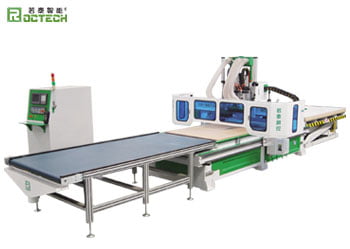
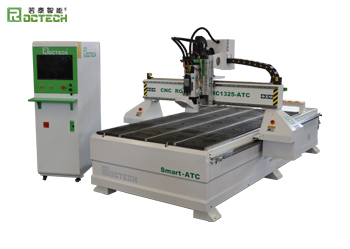
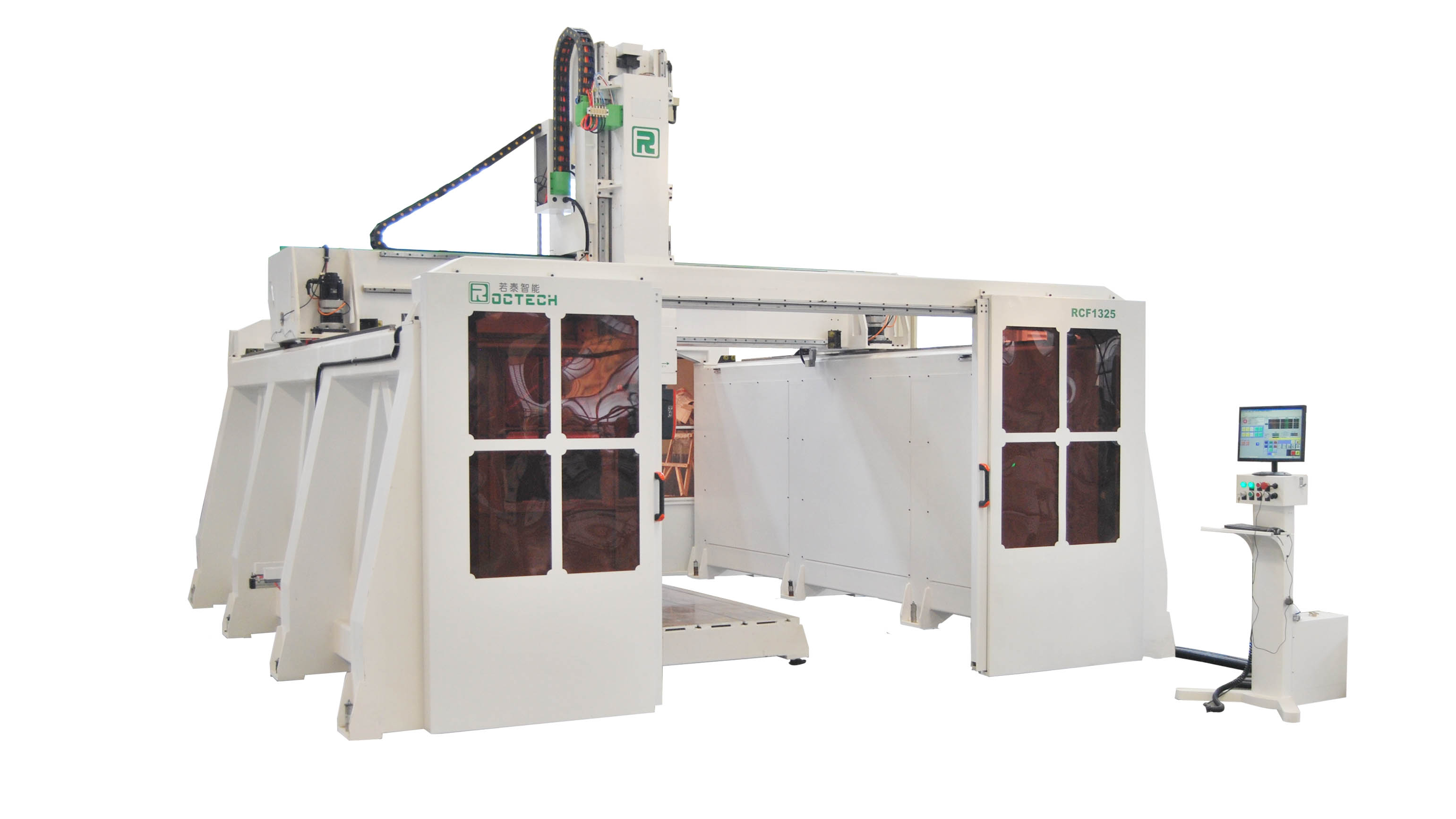
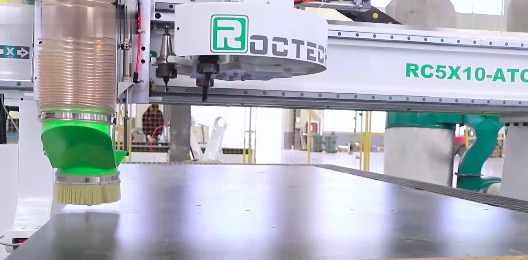
Roctech® (Roctech Machinery Co., Ltd.), headquartered in Jinan, Shandong, illustrates how a builder with roots in woodworking CNC has extended its platform architecture into adjacent material segments. The company's product range spans automatic loading and unloading nesting centers, ATC engraving machines, five-axis simultaneous machining centers, and fiber laser cutting systems, with exports to more than 100 countries. Its ATC series, for instance, pairs Taiwan HIWIN linear guides with Japan Yaskawa servo drives and Syntec control, offering 8–24 station tool magazines and spindle options up to 12 kW—a configuration philosophy that translates naturally to stone when the bed is stiffened, the ways are sealed, and coolant management is added. The RCF series five-axis machining center, with its imported five-axis head and OSAI control, represents the upper end of this trajectory and speaks to the company's stated ambition to move from equipment supply toward integrated intelligent manufacturing solutions.
For stone fabricators, the practical significance of this kind of product lineage is parts commonality and service reach. A shop running Roctech® nesting centers for cabinetry can extend into stone countertop work with a machine family that shares control conventions, spare-part channels, and operator training—an underappreciated factor in adoption decisions, since the cost of a new control paradigm often exceeds the cost of the iron itself.
Conclusion and Outlook
CNC stone carving automation is no longer a novelty reserved for large architectural fabricators. The combination of falling servo and control costs, maturing five-axis platforms, and persistent skilled-labor scarcity is pushing automated stone machining into mid-sized shops that would have dismissed it a decade ago. The remaining barriers are less about capability than about integration: dust and slurry management, tooling economics for abrasive materials, and the software chain that connects design intent to reliable tool paths.
Looking forward, two developments merit attention. The first is the continued convergence of woodworking and stone machine architectures, which will likely accelerate price competition and shorten innovation cycles. The second is the gradual arrival of automated loading and sensor-based tool-wear compensation in stone-specific platforms—capabilities already standard in panel furniture nesting. Builders positioned across both segments, Roctech among them, are plausibly advantaged in that transition, provided they invest as heavily in application engineering as in hardware specification. For fabricators, the strategic question is simpler: the machines are ready; the question is whether the workflow around them is.
Looking for more information about our CNC machines and services? Contact us today.
Contact





















Precision at the Edge: How CNC Stone Carving Automation Is Reshaping Modern Fabrication - Roctech® have advanced technology for CNC Router,cnc router cabinets,Roctech already have 15 years experiences of cnc router technology.-© 2023 Roctech®Machinery Co., Ltd. - Kaikki oikeudet pidätetäänVerkkosivuston käyttöehdot ● Tietosuojakäytäntö ● Evästekäytäntö