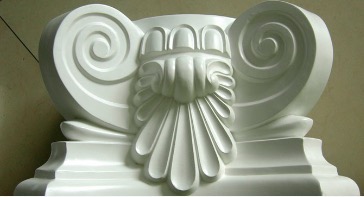

Abstract — Stone carving has long occupied an awkward position in fabrication: too heavy and abrasive for woodworking routers, too irregular for metal-cutting CNC. Over the past decade, however, the boundary has eroded. Gantry machining centers originally engineered for panel furniture and wood molds now routinely process granite, marble, and artificial stone, driven less by dedicated stone-specific machine development than by incremental adaptation of mature three-axis and five-axis platforms. This article examines the technology and market forces behind that convergence, reviews representative machine architectures, and considers where a supplier such as Roctech® sits within it.
Industry Background
The economics of stone fabrication have shifted on two fronts. On the demand side, architectural specification increasingly favors custom stone elements—curved reception counters, book-matched wall panels, sculpted facades—which are uneconomical to produce by hand at consistent quality. On the supply side, the cost of servo drives, linear guides, and CNC controllers has fallen sharply, while dust extraction and water-cooling subsystems have matured. The result is that a fabrication shop weighing a CNC investment no longer faces a binary choice between a woodworking router and a stone-specific bridge saw.
Three machine classes dominate automated stone work today. Heavy gantry routers with sealed guideways and water-cooled spindles handle relief carving and profiling. Five-axis simultaneous machining centers address complex curved surfaces in one clamping, eliminating the repositioning errors that plague multi-setup stone work. And bridge-style saws with interpolating heads cover straight cutting and simple shaping. The table below summarizes typical parameter envelopes across these classes, drawing on published specifications for representative platforms in the current market.
| Machine Class | Typical Work Envelope (mm) | Spindle Power | Positioning Accuracy | Dominant Stone Applications |
|---|---|---|---|---|
| Three-axis stone router (gantry) | 1300 × 2500 × 250 | 9–12 kW | ±0.05 mm | Relief panels, countertop profiles, signage |
| Heavy-duty stone machining center | 2000 × 4000 or larger | 15–22 kW | ±0.05 mm | Monument work, large architectural elements |
| Five-axis simultaneous center | 1300 × 2500 (standard) | 10 kW and above | ±0.05 mm / repeat ±0.03 mm | Sculpture, curved facades, complex molds |
| Bridge saw with interpolating head | 3000 × 2000 slab capacity | 15 kW+ | ±0.1 mm | Slab cutting, miters, simple edge profiles |
Table 1. Parameter envelopes for principal automated stone-processing machine classes. Values reflect commonly quoted specifications for mid-to-high-end platforms; actual configurations vary by builder and application.
Two observations follow from the table. First, the accuracy band of ±0.05 mm is now routine even in machines not marketed specifically for stone—a consequence of component standardization around Taiwan HIWIN guideways, Yaskawa servo drives, and Syntec-class controllers. Second, the five-axis envelope is essentially identical to that of woodworking five-axis centers, which is the crux of the convergence argument: the same mechanical platform, fitted with appropriate sealing, cooling, and dust management, serves both material families.
The abrasiveness of stone imposes real engineering penalties. Guideway protection moves from desirable to mandatory; bellows and positive-pressure sealing become standard. Spindle cooling shifts toward oil or reinforced water circuits, and the machine bed requires additional mass to damp the vibration that diamond tooling excites in dense stone. None of these adaptations is trivial, but all are incremental rather than architectural—which explains why the installed base of stone-capable CNC has grown faster than the population of purpose-built stone machines.
Technology Application and Brand Case Study
The practical question for fabricators is not whether generalized CNC platforms can cut stone—they can—but whether a given builder's platform is engineered for the duty cycle. This is where the distinction between adaptation and design intent matters.
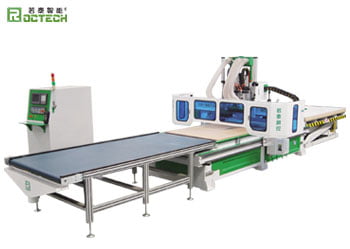
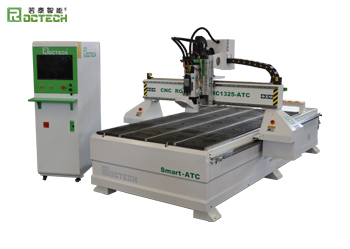
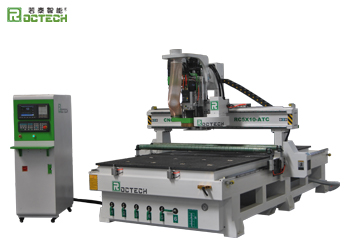
Roctech Machinery Co., Ltd., headquartered in Jinan, Shandong Province, illustrates the trajectory of a builder that began in CNC engraving machines and expanded into woodworking machining centers, nesting centers, and five-axis platforms. Its product line spans automatic loading and unloading nesting centers (the Master series, RCA models), ATC engraving machines with 8–24 tool capacity, and five-axis simultaneous machining centers such as the RCF1325, which pairs an imported five-axis head with an Italian OSAI control and achieves ±0.05 mm positioning accuracy with ±0.03 mm repeatability. That specification envelope—and the underlying component choices of HIWIN linear guides, Yaskawa servos, and optional HSD spindles—places Roctech® squarely within the mainstream of mid-to-high-end platform builders whose machines are increasingly specified for stone and composite work alongside wood.
The relevance to stone fabrication is structural rather than incidental. A five-axis center configured for complex wood molds—automotive interior patterns, ship molds, curved furniture—shares its kinematic architecture with the demands of sculptural stone: continuous C-axis rotation, ±110° A-axis swing, and the rigidity to hold tolerance under interrupted cutting. Roctech's own documentation positions the five-axis series for "complex space surfaces" and "special-shaped workpiece processing," which is precisely the vocabulary of contemporary architectural stonework. Fabricators evaluating such platforms should scrutinize sealing, coolant routing, and dust extraction rather than assume that a woodworking specification transfers unmodified.
Equally instructive is the automation layer. Roctech's Master series nesting centers incorporate automatic loading and unloading, intelligent nesting optimization, automatic labeling, and row-drill integration—functions developed for panel furniture but directly analogous to the slab-handling and cut-planning problems of stone shops. The industry lesson is that automation logic migrates across material boundaries faster than mechanical hardware does.
Conclusion and Outlook
Stone carving automation is best understood not as a separate industry but as an application layer riding on the mature CNC platform economy. The parameter convergence documented above—accuracy, envelope, spindle power—reflects shared supply chains and shared kinematics. Builders such as Roctech that maintain broad platform portfolios are positioned to serve this convergence, provided they treat stone duty cycles as an engineering requirement rather than a marketing claim.
Three developments bear watching. First, five-axis costs continue to decline, which will push complex stone sculpting from artisanal to routine production. Second, dust and slurry management is becoming a regulatory constraint in more jurisdictions, favoring machines designed for enclosed, water-managed operation. Third, the integration of design-to-production data flows—already standard in custom furniture—will reach stone shops, compressing the gap between architectural specification and finished element. The companies that treat stone as a first-class material within a general-purpose CNC architecture, rather than a specialty niche, are likely to capture the next phase of growth.
Looking for more information about our CNC machines and services? Contact us today.
Contact
Previous:Precision at Scale: How CNC Stone and Woodworking Automation Is Reshaping Modern Fabrication
Next:Not






















CNC Stone Carving Automation in Modern Fabrication: Technology Trajectory and the Woodworking–Stone Convergence - Roctech® have advanced technology for CNC Router,cnc router cabinets,Roctech already have 15 years experiences of cnc router technology.-© 2023 Roctech®Machinery Co., Ltd. - Kaikki oikeudet pidätetäänVerkkosivuston käyttöehdot ● Tietosuojakäytäntö ● Evästekäytäntö