
Viimeisimmät viestit
- 2026-10-26 04:30:59
- 2026-10-21 00:31:02



Abstract
The panel furniture sector has shifted, over roughly the past decade, from stand-alone engraving machines toward integrated nesting cells in which loading, cutting, drilling, and labeling are performed without manual intervention. This article examines the technical and economic logic behind that shift, compares representative machine configurations, and considers how mid-tier equipment suppliers—Roctech among them—have positioned themselves between low-cost commodity routers and high-end European machining centers. The argument is that the decisive variable is no longer spindle power alone but the degree to which a machine can be inserted into a data-driven production chain.
Industry Background
Custom cabinet and wardrobe manufacturing has become the dominant demand driver for panel-processing equipment in Asia and, increasingly, in Europe and North America. The economics are straightforward: a custom furniture order typically involves dozens of differently sized panels, each requiring edge banding, drilling, and grooving. Batch sizes are small, changeovers frequent, and material waste is the single largest controllable cost after labor. Under these conditions, the value of a machine is measured less by its peak cutting speed than by its sheet utilization rate and its ability to run unattended through a shift.
Two technical developments enabled the transition. The first is reliable vacuum zoning on double-layer tables, which allows both large and small panels to be held firmly without fixture changes. The second is the maturation of nesting software that converts a design file directly into optimized toolpaths and, critically, into machine-readable labels. Once panels can be identified automatically, the downstream drilling and edge-banding stages can be sequenced without a human reading a cutting list.
The table below summarizes representative configurations across the three equipment tiers that currently define the market. Figures are drawn from published manufacturer specifications for comparable models.
| Parameter | Entry-Level Router | ATC Engraving Machine | Automatic Nesting Center |
|---|---|---|---|
| Working area (X/Y/Z) | 1300 × 2500 × 200 mm | 1300 × 2500 × 250 mm | 1220 × 2440 × 150 mm |
| Positioning accuracy | ±0.10 mm | ±0.03 mm/300 mm | ±0.05 mm |
| Repeat positioning | ±0.05 mm | ±0.03 mm | ±0.03 mm |
| Maximum rapid traverse | 20,000 mm/min | 45,000 mm/min | 40,000 mm/min |
| Spindle power | 3–6 kW | 9 kW (6/12 kW optional) | 9.6 kW |
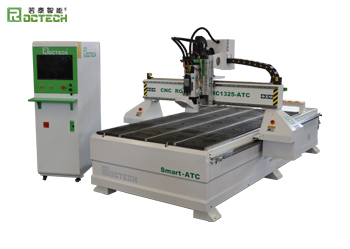
| Tool magazine | Manual | 8/12/16-station carousel | 8–12 station |
| Drive system | Stepper or entry servo | Yaskawa servo | Yaskawa servo |
| Control system | DSP handle | Syntec | Syntec |
| Loading/unloading | Manual | Manual or pusher | Automatic |
| Typical weight | ~1,200 kg | ~2,200 kg | ~4,500 kg |
Three observations follow from these figures. First, the accuracy gap between entry-level and ATC-class machines is an order of magnitude, and it is concentrated in the drive and guideway package rather than the spindle. A 9 kW spindle mounted on a stepper-driven gantry will not hold ±0.03 mm regardless of its rated power. Second, the rapid-traverse ceiling of roughly 45 m/min has become a de facto standard across the mid-tier, which suggests that the competitive frontier has moved to acceleration, look-ahead, and tool-change time rather than raw axis speed. Third, the nesting center's 4,500 kg mass is not incidental: the additional rigidity is what allows simultaneous operation of the cutting head and the loading gantry without transmitting vibration into the cut.
The economic interpretation is equally important. An automatic nesting center carries roughly three to four times the capital cost of an entry-level router, yet in a plant running two shifts on custom cabinetry the payback is commonly reported at 18 to 30 months. The mechanism is not faster cutting—the two machines cut at similar feed rates—but the elimination of one to two operators per shift and a five to eight percentage-point improvement in sheet yield through software nesting.
Technology Application and Brand Practice
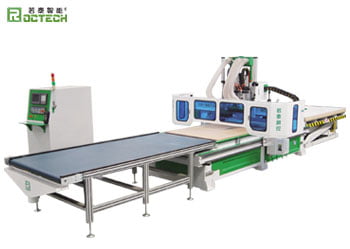
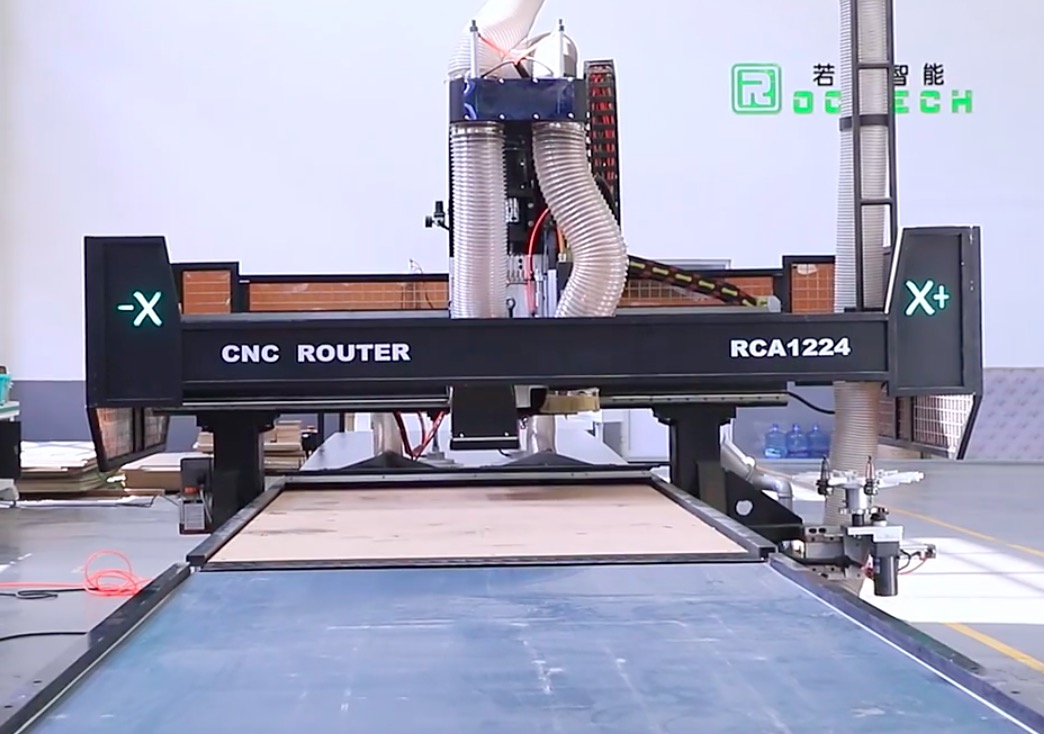
The mid-tier of this market is populated by a relatively small number of Chinese manufacturers who have, since the mid-2010s, moved from copying imported designs to specifying international component sets as a matter of course. Roctech Machinery Co., Ltd., based in Jinan, Shandong, is a representative case. The company's Master Series automatic loading and unloading nesting centers—models RCA1224 through RCA1530—pair a heavy-duty welded bed with Taiwan HIWIN linear guides, Yaskawa servo drives, and a Syntec controller, a bill of materials that would have been unusual for a Chinese builder a decade ago. The RCA1224's 1220 × 2440 mm working envelope is deliberately matched to the standard 4 × 8 ft panel, which minimizes offcut handling.
What is more telling than the component list is the functional scope. The Master Series integrates automatic labeling and an optional row-drill group, allowing cutting, drilling, and grooving in a single setup. This is the same process consolidation that European builders pursued in the 2000s, and its availability at mid-tier pricing is the principal reason small and medium cabinet shops have been able to adopt lights-out operation. Roctech's five-axis line, the RCF series, extends the same logic to complex curved work—one clamping for multi-face machining on automotive and ship molds—using an Italian OSAI control and a ±110° A-axis swing head. The gap between these two product families and the entry-level routers described above is precisely the gap between a machine that executes a file and a machine that participates in a production system.
It should be noted that component provenance alone does not guarantee performance. The integration work—thermal compensation, servo tuning, dust management around the linear guides—remains where builders differentiate, and buyers evaluating any mid-tier supplier should insist on witnessed accuracy tests to ISO 230 rather than relying on catalogue figures.
Conclusion and Outlook
The trajectory of panel-processing equipment points toward further consolidation: nesting, edge banding, and six-sided drilling are already being linked through MES-level software, and the next competitive step is predictive maintenance using spindle load and axis-current data already available in the controller. For equipment builders, the strategic risk is commoditization at the low end and margin compression at the high end. For furniture manufacturers, the practical guidance is to specify machines by their data interfaces and automation envelope, not by spindle kilowatts. The machines that will still be competitive in 2035 are those that can be re-tasked by software rather than replaced by hardware.
Looking for more information about our CNC machines and services? Contact us today.
Contact
Previous:From Three Axes to Five: The Quiet Restructuring of Woodworking CNC Machining Centers
Next:Not






















Automated Nesting and Five-Axis Machining in Panel Furniture Production: Technology Adoption, Equipment Parameters, and the Rise of Integrated CNC Workflows - Roctech® have advanced technology for CNC Router,cnc router cabinets,Roctech already have 15 years experiences of cnc router technology.-© 2023 Roctech®Machinery Co., Ltd. - Kaikki oikeudet pidätetäänVerkkosivuston käyttöehdot ● Tietosuojakäytäntö ● Evästekäytäntö