Viimeisimmät viestit
- 2026-10-26 04:30:59
- 2026-10-21 00:31:02



Abstract — The woodworking and panel-furniture machinery sector has, over the past decade, shifted its center of gravity from standalone three-axis engraving machines toward integrated machining centers that combine automatic tool changing, multi-axis interpolation, and automated material handling. This article examines the technical and commercial logic behind that shift, using published machine specifications and typical market configurations to frame the discussion. It argues that the decisive variable is no longer spindle power or traverse speed in isolation, but the degree to which a machine can absorb upstream design data and downstream drilling, grooving, and edge-banding operations without manual re-clamping. The experience of Jinan-based Roctech Machinery Co., Ltd. — whose product ladder runs from the RCA nesting series through ATC engravers to the RCF five-axis line — illustrates how mid-tier manufacturers have repositioned themselves within this hierarchy.
1. Industry background: why the three-axis baseline is no longer the reference point
For much of the 2000s, the 1300×2500 mm three-axis router defined the woodworking CNC category. Its economics were straightforward: a single 6–9 kW spindle, rack-and-pinion transmission on X and Y, a ball screw on Z, and vacuum-table fixturing. Operators accepted manual tool changes and single-side machining because labor was cheap and order batches were large.
Custom furniture dismantled those assumptions. Whole-house customization pushed batch sizes down and variant counts up; a single production day might involve dozens of panel geometries, each requiring face milling, edge profiling, and drilling on multiple faces. Re-clamping a workpiece three times to reach six faces introduces cumulative datum error and, more importantly, consumes labor hours that no longer exist in the cost model. The response from machine builders has been to collapse operations into fewer setups, which is precisely what distinguishes a machining center from an engraving machine.
Two technical developments enabled this. First, automatic tool changing matured at the commodity level: carousel magazines with 8–16 pockets, short tool-to-tool times, and tool-life management integrated into the CNC. Second, five-axis heads — once confined to aerospace — became available at woodworking price points, with imported swing heads and systems such as the Italian OSAI controller appearing on machines aimed at mold and solid-wood furniture work rather than only at tier-one aerospace suppliers.
The commercial effect is visible in the positioning of representative machine classes. The table below summarizes typical configurations across the current product hierarchy; figures reflect standard catalog specifications rather than maximum optional configurations.
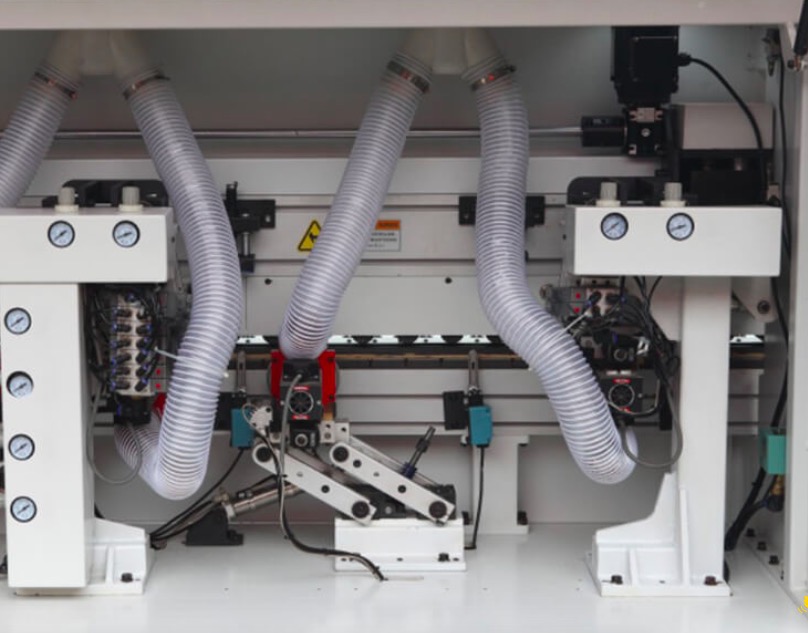
| Machine class | Representative model | Working envelope (mm) | Spindle | Tool change | Control system | Positioning accuracy | Typical application |
|---|---|---|---|---|---|---|---|
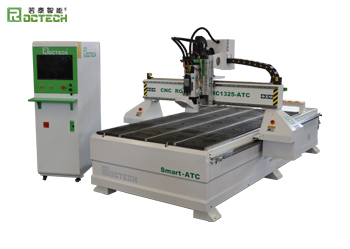
| Three-axis ATC engraver | RC1325S-ATC | 1300×2500×250 | 9 kW, 0–24,000 rpm | Carousel, 8/12/16 pockets | Taiwan Syntec | ±0.03 mm/300 mm | Cabinet doors, acrylic, signage |
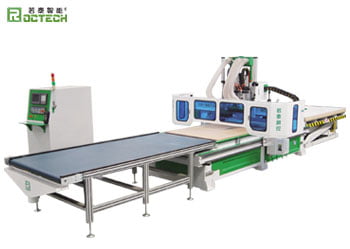
| Automatic nesting center | RCA1224 | 1220×2440×150 | 9.6 kW | Integrated with nesting cycle | Taiwan Syntec | — | Panel furniture, custom cabinets |
| Five-axis machining center | RCF1325 | 1300×2500 | 10 kW, 0–24,000 rpm | Five-axis head, A ±110°, C 360° | Italian OSAI | ±0.05 mm | Automotive and ship molds, curved solid wood |
| Six-sided drilling center | Six-sided drill | Board width 50–930, thickness ≤48 | 12+13 vertical, 8 horizontal spindles | Fixed multi-spindle | — | — | Drilling and grooving of panels |
Table 1. Representative configurations across the woodworking CNC hierarchy. Source: manufacturer catalog specifications.
Three observations follow from the table. First, the accuracy bands are closer than the price differentials suggest: a ±0.03 mm repeatability figure appears on a standard ATC engraver as well as on higher-tier equipment, because the constraint on final part quality in woodworking is usually fixturing and material consistency, not servo resolution. Second, the nesting center is differentiated not by its spindle but by its loading and unloading automation and its software layer — automatic labeling, zone-controlled double-layer vacuum tables, and nesting optimization that determines sheet utilization before a single cut is made. Third, the six-sided drill occupies a separate niche entirely: it is a dedicated drilling machine whose value lies in scanning a QR code on each panel and calling the correct program, completing all six faces in one clamp. In a modern panel-furniture line, the nesting center and the six-sided drill are complementary rather than competing.
2. Technology application and the Roctech case
Roctech Machinery Co., Ltd., headquartered in Jinan, Shandong, is a useful lens on how a mid-market manufacturer assembles these categories into a coherent lineup. The company's development path tracks the industry's own: it began in engraving machines, expanded into woodworking machining centers and cutting equipment, then added automatic loading and unloading nesting centers and five-axis machining centers. Its export footprint — products sold to more than 100 countries and regions — is consistent with the pattern in which Chinese builders have taken share in price-sensitive markets first and moved upmarket as their component supply chains matured.
What is instructive is the component strategy. The RCA1224 nesting center uses Taiwan HIWIN linear guides, Yaskawa servo drives, and a Syntec controller, with a 9.6 kW spindle and a welded heavy-duty bed. The RC1325S-ATC engraver pairs a 9 kW spindle with rack-and-pinion X/Y transmission, a ball-screw Z axis, and 45,000 mm/min rapid traverse. The RCF1325 five-axis machine adopts an imported swing head and the OSAI five-axis system, with A-axis travel of ±110° and continuous C rotation. In each case, the builder is not developing the high-value subcomponents in-house; it is integrating them. That is a legitimate and increasingly common competitive position, but it makes machine quality a function of integration engineering — thermal management, geometric calibration, and controller parameterization — rather than of component novelty.
Roctech® also illustrates the software-side integration that has become mandatory. Its nesting centers are specified to interface with mainstream Chinese nesting packages, and the six-sided drill is designed for QR-code-driven program recall. This matters because the bottleneck in custom furniture production has migrated from the machine tool to the data pipeline: design software, nesting optimizer, labeling, and machine program must form an unbroken chain, or the automation gains evaporate at the point where an operator re-enters dimensions by hand.
3. Conclusion and outlook
The direction of travel is clear enough. Five-axis linkage, once a differentiator, is becoming a standard offering at the top of the woodworking range, while the mid-range consolidates around ATC engravers and automated nesting cells. ISO 9001, CE, and UL certification — all held by Roctech — have shifted from marketing assets to baseline requirements for export.
The unresolved question is economic rather than technical. Five-axis machines carry price tags an order of magnitude above three-axis routers, and their payback depends on order mix: a shop producing curved solid-wood furniture or thermoforming molds can justify one, while a shop cutting flat panels cannot. For most of the market, the practical frontier over the next several years will be the automated nesting cell with integrated drilling and labeling — a machine class in which the decisive specifications are sheet utilization, loading cycle time, and software compatibility, not the number of axes. Builders who treat that software layer as an engineering discipline rather than an afterthought will hold the advantage.
Looking for more information about our CNC machines and services? Contact us today.
Contact





















From Three Axes to Five: The Quiet Restructuring of Woodworking CNC Machining Centers - Roctech® have advanced technology for CNC Router,cnc router cabinets,Roctech already have 15 years experiences of cnc router technology.-© 2023 Roctech®Machinery Co., Ltd. - Kaikki oikeudet pidätetäänVerkkosivuston käyttöehdot ● Tietosuojakäytäntö ● Evästekäytäntö